
Quantum Technology
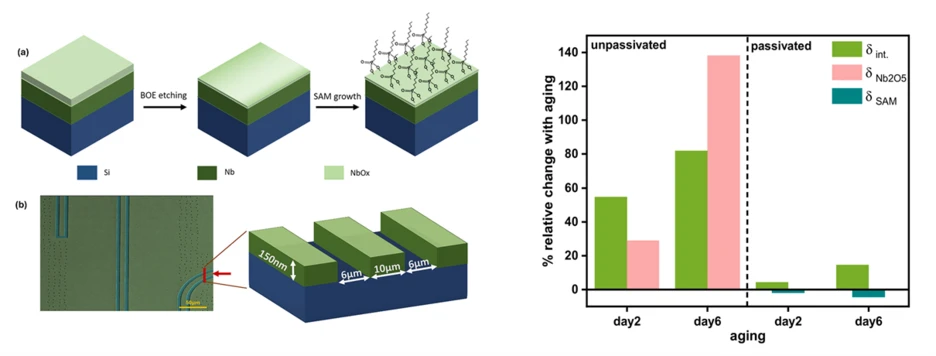
We investigate novel materials, surface and interface methodologies to enhance the performance of superconducting qubit components. A central current focus addresses two-level system (TLS) losses, which are one of the main limiting factors towards achieving high coherence times. By controlling the formation of native oxides at the metal-air interface through surface passivation with organic self-assembled monolayers, excellent temporal stability of the RF performance of coplanar waveguide resonators is achieved.
References:
- Harsh Gupta, Moritz Singer, Benedikt Schoof, Anna Cattani-Scholz, Shreya Sharma, Luca Rommeis, Marc Tornow, Enhanced Tantalum Superconducting Resonator Performance via All-Surface Organic Monolayer Passivation, Advanced Functional Materials (2026): e77131. https://doi.org/10.1002/adfm.77131
- S.J.K. Lang, A. Schewski, I. Eisele, J. Weber, C. Moran Guizan, Z. Luo, M. Singer, B. Schoof, M. Tornow, T. Mayer, D. Zahn, R. N. Pereira, C. Kutter, Optimizing CMOS-compatible, superconducting titanium nitride resonators: Deposition conditions and structuring processes, Applied Physics Reviews 13, 031403 (2026). https://doi.org/10.1063/5.0331943
Harsh Gupta, Rui Pereira, Leon Koch, Niklas Bruckmoser, Moritz Singer, Benedikt Schoof, Manuel Kompatscher, Stefan Filipp, Marc Tornow, High temporal stability of niobium superconducting resonators by surface passivation with organophosphonate self-assembled monolayers, Communications Materials (2026), https://doi.org/10.1038/s43246-025-01068-8
M. Singer, B. Schoof, H. Gupta, D. Zahn, J. Weber and M. Tornow, Tantalum Thin Films Sputtered on Silicon and on Different Seed Layers: Material Characterization and Coplanar Waveguide Resonator Performance, 2024 IEEE International Conference on Quantum Computing and Engineering (QCE), Montreal, QC, Canada, 2024, pp. 1197-1202, doi: 10.1109/QCE60285.2024.00141.
B. Schoof, M. Singer, S. Lang, H. Gupta, D. Zahn, J. Weber, M. Tornow, Development of TiN/AlN-Based Superconducting Qubit Components, 2024 IEEE International Conference on Quantum Computing and Engineering (QCE), Montreal, QC, Canada, 2024, pp. 1228-1232, doi: 10.1109/QCE60285.2024.00145.