
Parametric control of nanomechanical networks
A swing can be driven without a push. The rider stands up at the lowest point and squats at the turning points. This changes the effective pendulum length twice per oscillation. Energy flows into the swing, and the amplitude grows. This is parametric amplification: the system is driven by modulating one of its parameters, not by an external force.

The same principle works at the nanoscale. We periodically modulate parameters of nanomechanical resonators, such as their resonance frequency. This lets us amplify, couple and reconfigure mechanical modes. We study these mechanisms in networks of coupled nanomechanical resonators. Our work combines nonlinear dynamics with concepts from quantum and wave physics.
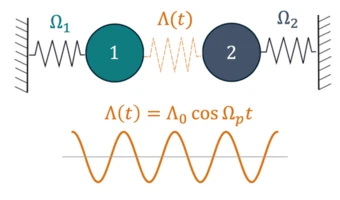
The swing pumps a single mode at twice its frequency. Modulation at the sum or difference of two mode frequencies instead couples two different modes. Such parametrically coupled modes behave like a driven two-level system. In a Floquet description, the modulation creates quasienergies and Autler–Townes splitting, as in coherent control of quantum systems. This analogy gives a common framework for classical nanomechanics and quantum physics. Control concepts developed in the classical regime can later be transferred to the quantum regime.

Methods
Our resonators are silicon nitride nanostrings, which we fabricate ourselves. Electrodes next to the string drive it dielectrically. The same electrodes tune its resonance frequencies. A modulated voltage therefore modulates the mode frequencies and their coupling. This is how we implement parametric control. We detect the motion with microwave cavity-assisted heterodyne detection. Optical interferometry offers a second, independent detection scheme.
On the theory side, we use perturbation methods such as the method of multiple scales. They reduce the fast oscillations to slow equations for amplitude and phase. From these, we obtain analytical conditions for instabilities, steady states and their stability. Numerical simulations complement the analysis where needed. We compare the measured response directly with these predictions.
Current research directions
Parametric coupling and Floquet dynamics. We use sum- and difference-frequency modulation to control interactions between mechanical modes. We describe the resulting dynamics with Floquet quasienergies.
Parametric instabilities and nonlinear dynamics. We study how parametric instabilities set in and evolve. This includes nonlinear steady states, limit cycles, and the interplay between parametric coupling and intrinsic nonlinearity.
Non-Hermitian dynamics and exceptional points. Parametric modulation shapes the effective mode spectrum. We use it to reach and control exceptional points in driven, dissipative coupled-mode systems.
Nonreciprocal mechanical dynamics. Parametrically controlled interactions can break symmetries. We exploit this for directional response and energy transfer in nanomechanical networks.
Mechanical squeezing. Parametric modulation can reduce fluctuations in one quadrature of motion. This is a route from classical parametric control toward mechanical quantum-state engineering.
Long-term goal
We aim to build nanomechanical networks whose interactions are programmed by parametric modulation. Such networks would allow controlled amplification, state preparation and directional transport on one mechanical platform.
Funding and Duration
Sonderforschungsbereich (SFB 1432) - Deutsche Forschungsgesellschaft
Seed funding – Munich Center for Quantum Science and Technology
Cooperation Partners
Technische Universität München TUM
Universität Konstanz, University of Massachusetts Lowell, Michigan State University
Contact
Principal Investigator: Prof. Eva Weig
Project Lead: Dr. Ahmed Barakat