
Microwave to optical transduction mediated by magnons and phonons
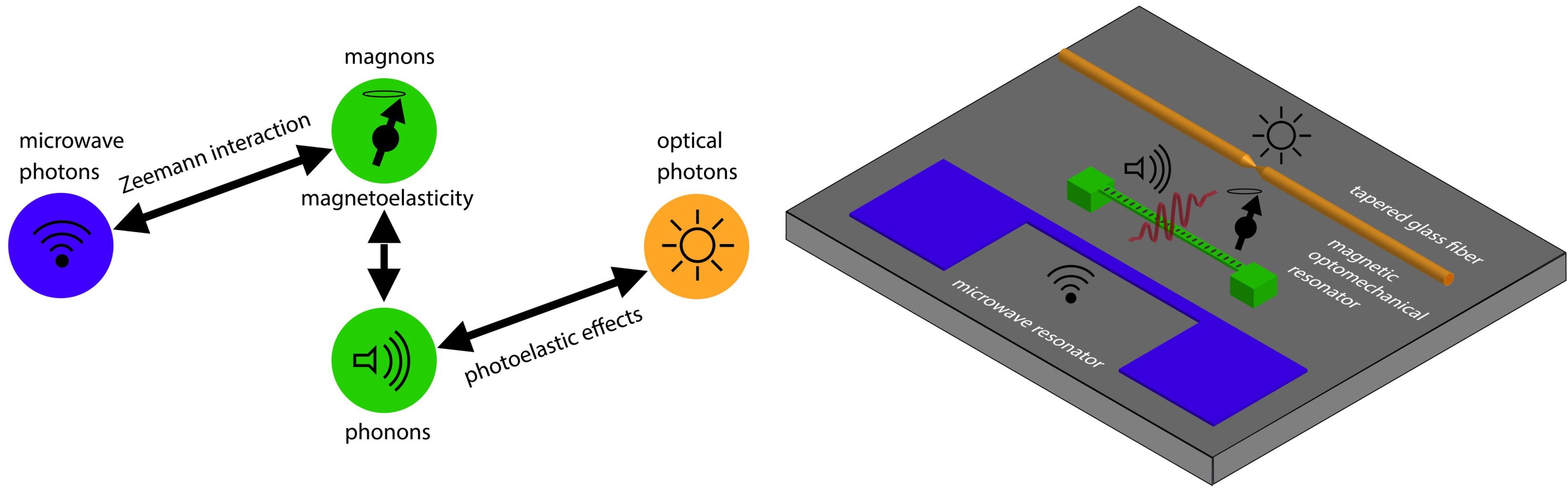
To establish remote connections between quantum systems operating at microwave frequencies, such as superconducting quantum information processors at cryogenic temperatures, one needs to transduce from microwave to the optical (MWO) domain. Photons interact weakly with their environment, thereby minimizing energy loss and preserving quantum states over long distances. Particularly photons in the C-band (1550 nm) are suitable. Additionally, photons are not subject to thermal noise, which helps maintain coherence. Therefore, existing optical fibers can be used for long-distance communication at optical frequencies. We propose a three-step transduction process involving phonons (quantized lattice vibrations) and magnons (quantized spin waves in magnetic materials) to realize MWO transduction.
The three-step transduction process relies on following strong coupling interactions:
1. Microwave-to-Magnon Coupling: Microwave photons are coupled from a microwave resonator to magnons in a magnetic material of an ultra-low-damping yttrium iron garnet (YIG).
2. Magnon-to-Phonon Coupling: Magnonic excitations are coupled to tailored phononic modes within the same magnetic material.
3. Phonon-to-Optical Coupling: Phononic modes interact with optical photons via an opto-mechanical crystal, enabling the conversion to optical frequencies suitable for fiber-optic communication.
While this approach introduces additional complexity, it offers the benefits of high conversion efficiency and conversion bandwidths in the MHz range. In this project, a proof-of-principle nanodevice will be realized by combining a YIG ferrite optomechanical crystal with a superconducting microwave cavity that mediates microwave-to-optical transduction.
By leveraging the unique properties of phonons and magnons, and their interactions, this three-step transduction process provides a promising pathway to enable efficient quantum networks by bridging the gap between microwave and optical frequencies.
See: Engelhardt et al., Phys. Rev. Appl. 18, 044059 (2022)
Funding and Duration
Munich Quantum Valley,
Duration: 2023-2025
Cooperation Partners
Technische Universität München TUM
External: Walther-Meissner-Institut WMI (PD Dr. Hans Hübl)
Contact
TUM: Prof. Eva Weig,
External:
Doctorial Candidates: Jonny Qiu, Matthias Grammer (WMI)
Homepage